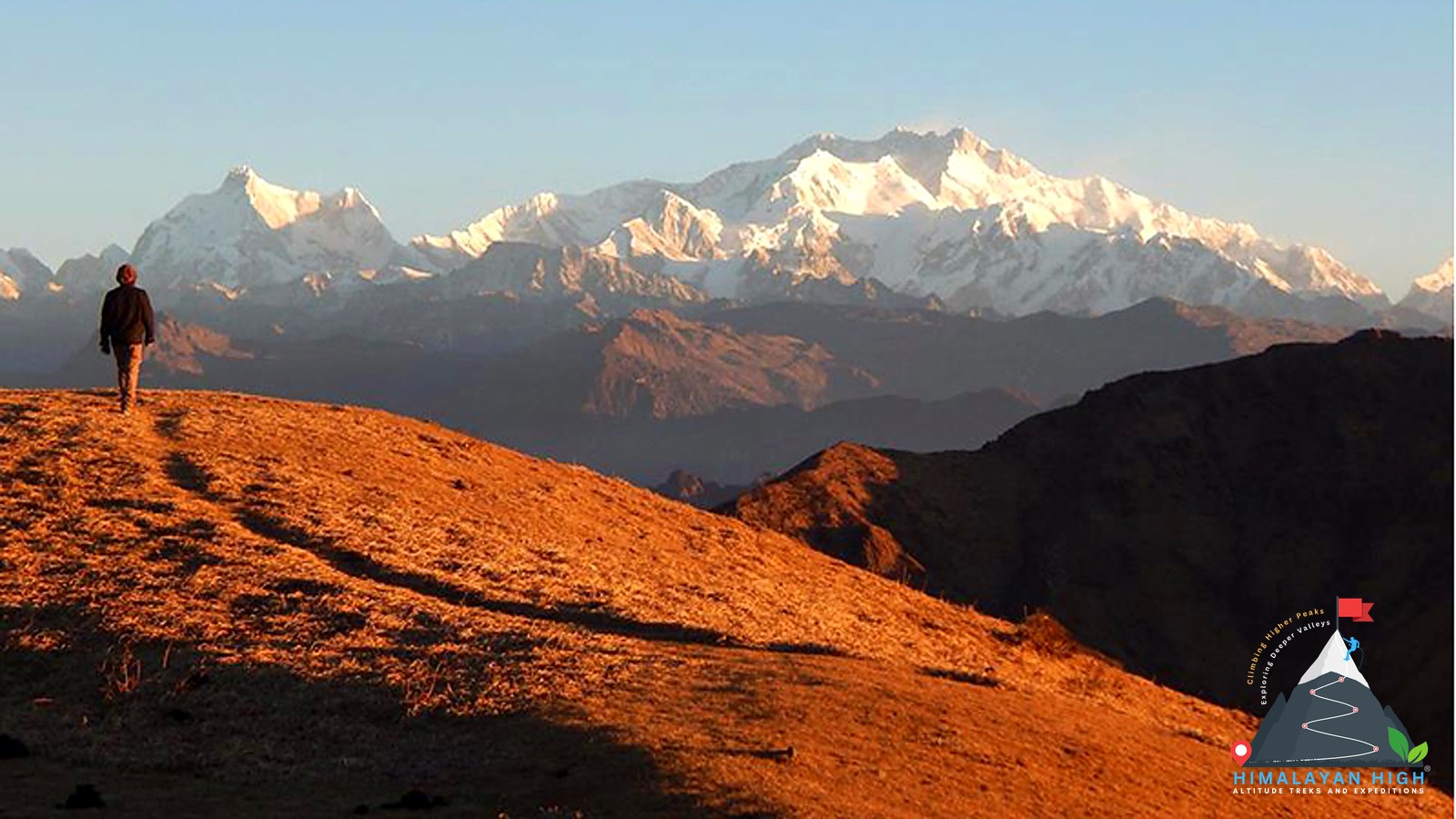
Most people who climb to Sandakphu turn round the next morning. They've seen Everest and Kanchenjunga at sunrise, and the walk feels done.
It isn't. The quietest, widest and closest part of the Singalila Ridge starts the day you leave Sandakphu behind and walk on to Phalut.
The 30-second version
- You keep the height you worked for. It takes three days to climb to Sandakphu. The short version gives it all back in one long, steep day down.
- You walk towards the mountains, not away. Every day after Sandakphu brings Kanchenjunga closer, until Phalut, the nearest point on the ridge.
- The crowd stops at Sandakphu. Beyond it the trail runs over open meadow and through rhododendron forest, with very few people on it.
- The Sleeping Buddha looks its best from Sabargram and Phalut. The angle there makes the shape of the range come together.
- You end in Gorkhey and Samanden, two river-valley villages that feel like a childhood drawing come true.
- It costs you about two more days. Our full Sandakphu Phalut trek takes 7 days from Bagdogra, with a night at Phalut for its sunrise.
Why so many people stop at Sandakphu
Sandakphu, at 3,636 m, is the highest point in West Bengal, and it's famous for good reason. From one viewpoint you see four of the five highest mountains on earth: Everest, Lhotse, Makalu and Kanchenjunga, with the Kanchenjunga range lying across the horizon like a sleeping Buddha.
So Sandakphu becomes the goal. The short trek goes up, catches a sunrise and comes down, sometimes because people have only a few days, and sometimes because nobody told them what lies beyond. A road reaches Sandakphu too, and by then the trail can feel busy.
What changes after Sandakphu
The day after Sandakphu, the trail runs north along the ridge towards Sabargram and Molley. It's long but gentle, mostly level, over open meadow and through forests of rhododendron and magnolia. Everest, Makalu and Lhotse stay on your left, and Kanchenjunga grows ahead of you. In spring the rhododendrons are in bloom; in autumn the views are at their clearest.
For many trekkers this is the best day of the walk. It's also the quietest. The Land Rovers and most of the walkers have already turned round.
Walking towards the mountains
It takes three days to climb from Maneybhanjyang to Sandakphu. Head down the next day and you lose all of it in one long, steep descent, and see very little of the high ridge.
Walk on to Phalut and you stay high for two more days, with the mountains in front of you the whole way. That's also why we don't run the ridge the other way round. Starting from Sepi, walking up to Phalut and then back towards Sandakphu, you spend your best days with the view behind your back.
A night at Phalut, a sunrise to yourself
Phalut is the remotest stop on the route: open meadow, close to the big peaks, with nothing around but the ridge. We spend the night there so you can walk up to the sunrise point, at 3,700 m, the next morning. Passing through Phalut in the middle of a day isn't the same.
From Sabargram and Phalut the Sleeping Buddha looks its finest. The same range is visible from Tiger Hill in Darjeeling and from Pelling in Sikkim, but from those angles the shape doesn't come together the way it does here.
Down to Gorkhey and Samanden
Remember the village you drew at school? Huts by a stream, mountains behind, a blue sky with a few white clouds and birds overhead. That's Gorkhey. After Phalut, the trail drops off the ridge into a river valley, to Gorkhey and its twin village of Samanden, with wide fields and scattered homes. Many of our trekkers have asked for an extra day there.
From Gorkhey, the last walk runs through Rammam to Sepi, and the drive home.
A Christmas night in Gorkhey
In December 2015, a man who had never trekked before joined us on the Sandakphu Phalut trek. He was a new father with a busy business, and he'd chosen this route from our beginners' list. He later wrote that the night of 25 December in Gorkhey, in a family homestay, was the best Christmas night he'd ever spent.
The same week, another small team was due to sleep at crowded Sandakphu. Their trek leader moved them on to quieter Aalley instead, a short walk further and just inside Nepal. Today Aalley is where our groups sleep. (We've kept names private; the stories are real.)
Which version fits your days?
- Sandakphu Phalut trek, 7 days: Maneybhanjyang to Sepi, via Kalapokhari, Aalley, Molley, Phalut and Gorkhey. The whole ridge, and the one we recommend.
- Phalut trek, 6 days: from Sepi up to Phalut and down to Gorkhey. It skips Sandakphu, but if you're coming this way, Phalut is the better half of the ridge.
- Sandakphu short trek, 5 days: Maneybhanjyang to Sandakphu and down to Gurdum, if you truly have only a few days.
- Phoktey Dara trek, 7 days: a quieter approach from Uttarey in Sikkim, with camping, to Phalut and Gorkhey.
- Slower and specialist versions on the trek page: a 9-day version for serious photographers, and 7-day and 6-day versions for foreign passport holders.
- By Land Rover, 6 days: the ridge by road, for families and anyone who can't walk far.
Every version is private: your dates, your pace, and nobody joins your group. Choose Lean, Standard or Premium, come solo or as ten. On this route an experienced local trek leader covers both leadership and guiding. Trekking alone? Read Trekking solo? The whole Himalayas are yours!
Questions people ask
Is Phalut worth the extra days? Yes, if you can spare them. You stay high for two more days, walk towards Kanchenjunga, sleep at Phalut for its sunrise and end in Gorkhey. Most people who skip it hear about it later.
How hard is the walk from Sandakphu to Phalut? It's long but easy: mostly level ridge and meadow, with small ups and downs. Sandakphu to Molley is about 16 km, and Molley to Phalut about 9 km.
Where do we sleep? In homestays and trekkers' lodges along the ridge. We stay at Aalley rather than Sandakphu, then Molley, Phalut and Gorkhey.
When is the best time to go? October to mid-December for the clearest views, late December to February for snow, and March to mid-May for rhododendrons. The national park closes in the monsoon, from the end of May to the end of September.
Can I walk to Phalut without going to Sandakphu? Yes. Our Phalut trek starts from Sepi and goes straight up to Phalut, then down to Gorkhey.
Want to plan it your way? See the full Sandakphu Phalut trek, or read Darjeeling, Sikkim or Nepal? for the other ways to stand before Kanchenjunga.