At minus thirty on a frozen river, comfort is not a luxury. It is part of safety. A warm night's sleep, hot food and a leader who watches every trekker are what get you up the Zanskar and back.
The Chadar is one of the most extreme treks in the world. This is how we run it, so that you have a safe, comfortable and memorable time on it, even in hostile winter conditions.
At a glance
- Our work ethics
- A private team, light on a crowded route
- A qualified, experienced support team
- Comfortable sleeping, in camps and in hotels
- A hospitable camp
- Well-planned food
- Medical safety and time to acclimatise
- Safety gear for an extreme trek
- Care for our staff, and a leader with authority
Our work ethics
On all our treks, we work to bring out the natural, inborn sense of adventure in every person, rather than lead people by the hand. We promote the culture of adventure sports, and treat trekking not as a leisure activity for fun in the mountains, but as a sport. Every sport has rules, and we follow them in a true sporting spirit.
We never let a careless attitude grow in our team for the sake of pleasure, fun or fame. That holds for our staff and for our trekkers. We want to work with like-minded, responsible people from all over the world. After all, the fun you have on a trek comes at a cost to nature, so we keep our footprint as small as we can, above all in an ecological zone as sensitive as this one. Read Leave No Trace.
A private team, light on a crowded route
Every trek we run is private: only your own people, at your pace. This matters on the Chadar, because it is one of the most popular routes in Ladakh, and it is very crowded. Everyone wants to get it done, but very few want to live it. We can't help the crowd on the route. We can do our bit: keep our impact on the ecology small, and keep our trekkers focused on the river and the mountains. Read why we trek in smaller groups.
The Chadar is a porter-supported trek, and it faces a serious shortage of good people. The season is less than two months long, and there are only so many local Zanskaris to go round, so experienced, professional porters are scarce. Supporting a team well takes a large number of porters.
A qualified, experienced support team
Safety comes first on every trek we run. Our guides, trek leaders and local support staff are very good at what they do. They have worked in the mountains for a long time, they are deeply experienced in looking after our trekkers with real hospitality, and they know this trek well, because they have run it many times. Knowledge is what makes them a help on the trail, and they are responsible, capable people.
Comfortable sleeping, in camps and in hotels
The equipment we use is among the best available, and some of it is custom-made for a safe and comfortable trek. From double-layered insulated tents to multi-layered sub-zero sleeping bags, we take great care that you sleep well, in camp and in your hotel.
- Sleeping bags: light, with a high warmth-to-weight ratio, imported and made for the demands of this trek. We top them up with one or two fleece liners, as each trekker needs, for extra warmth and hygiene. They are not the heavy, bulky bags you may see elsewhere on the route.
- Mattresses: not the usual rubber or thin black foam. We use a thick foam mattress, about 1.5 inches thicker, with a waterproof cover, so your camp bed is well insulated, well cushioned and cosy.
- Hot water: we give you plenty of hot water on the trek, and every trekker gets a one-litre hot water bag to warm the inside of the sleeping bag.
- Hotels in Leh: centrally heated, at no extra cost to you. Central heating depends on Leh's electricity supply, which has been far more reliable since the Alchi hydroelectric project was completed.
All this makes sure you sleep well on the trek, and good sleep shapes your whole experience.
A hospitable camp
We give you a camp that is not luxurious, but hospitable. A separate dining tent means you eat well, seated on a camping chair rather than standing or sitting on the ground. In that freezing cold, a chair to sit on at meals is our bit to make dining good enough. The camp toilets are dry toilets, but we take the trouble to carry toilet seats with us to make them easier for you.
Well-planned food
The food we serve is made for the conditions, and our past trekkers have had many good things to say about it. We provide utensils and care for our camp helpers too.
In such dry cold, hot soups and soupy noodles are a real need. We serve plenty of nutritious hot food, because your body is working hard to cope with the cold and keep your core organs warm, and the altitude drains your energy reserves further. So, a hot mango juice to top up your energy, or a hot gulab jamun to treat your taste buds: we do what we can to feed you well. Good food means good sleep, and a body in good condition for the trek.
Medical safety and time to acclimatise
We understand how serious the altitude of Ladakh is, above all in the hostile winter months, so our team stays alert to every trekker's health.
- An extra day in Leh: our itinerary is one day longer, with an extra acclimatisation day in Leh, so you are safe and enjoy the trek. On this rest day we take you around Leh to show you the beauty of Ladakh in winter. It helps you relax and acclimatise better for the hard days ahead.
- Active at camp: each day at camp, the leader takes you for a walk around, so that you don't fall asleep but stay well acclimatised.
- Food for acclimatisation: our food is planned with acclimatisation in mind: garlic soup, for example.
- Trained leaders: our leaders have the knowledge, experience and practical skill to handle medical emergencies on the trek.
- Oxygen, carried by the leader: we carry oxygen cylinders on the trek. The cylinder is carried not by a porter, but by our leaders themselves, who walk with the trekkers.
- Pulse oximeter: we carry one and check every trekker's blood oxygen saturation as part of a general health check in those conditions.
- Medical kit: ours has all the important medicines needed on a trek like this. See Himalayan Medical Kit: A Must Have.
Know the warning signs yourself too: High Altitude Seriousness.
Ladakh's own rules for Chadar trekkers
The Ladakh administration sets its own rules for the Chadar trek, such as acclimatisation days in Leh, medical checks, insurance and permits. These can change from one winter to the next. We confirm the current rules with you when we plan your trek, and build them into your itinerary.
Safety gear for an extreme trek
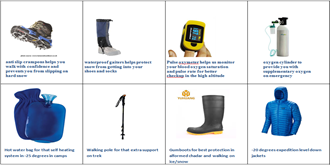
We provide all the safety gear the trek needs, such as helmets, anti-slip crampons and gaiters. As students of mountaineering ourselves, we understand why this gear matters. To save you the trouble of arranging them, we also provide gumboots, the most essential thing on this trek. We take care of everything needed for a safe and comfortable trek, even in extreme temperatures and hostile conditions.
On top of that, we provide our expedition-quality down jackets, trekking poles and waterproof ponchos to trekkers who don't want to buy them, because they are very expensive for one-time use. What to bring yourself: How Should You Prepare For The Chadar Trek.
Care for our staff, and a leader with authority
We never neglect the quality of our local team, the cooks and porters. We hire responsible local people for your team, and one of our own leaders goes with them. The leader makes sure the service is delivered as promised, and links the team with the local crew.
We make sure our staff don't work in inhospitable conditions on top of an already extreme climate: waterproof gloves, for example, and hot water to wash the utensils. In return, they leave nothing undone to give you, and us, a better and more satisfying experience.
Why this is not the lowest-priced Chadar
We do all of this so that you have a lovely, memorable, safe and comfortable time on one of the most extreme treks in the world. Doing it properly costs more than a low-cost trek, and our Chadar trek is priced for the care that goes into it. We put the experience first, and we are glad that people choose us for our values, our work ethics and the warm service we give, even in such inhospitable conditions.
Plan your Chadar trek
The Chadar runs in January and February. See our Chadar Trek, or the longer Classical Chadar Trek to Zangla and Padum. Before you go, read the difficulties of the Chadar trek, and for the rest of the year, see our Ladakh treks.
Questions trekkers ask
Is the Chadar trek safe?
It is an extreme trek, and it carries real risks from altitude, cold, weather and ice. With time to acclimatise in Leh, proper gear, trained leaders who carry oxygen and a pulse oximeter, and a careful team, those risks are well managed.
How cold is it at night in camp on the Chadar?
Very cold. That is why we use double-layered insulated tents, sub-zero sleeping bags with fleece liners, thick insulated mattresses and a one-litre hot water bag for every trekker.
What gear do you provide on the Chadar trek?
Helmets, anti-slip crampons, gaiters and gumboots, and, for those who don't want to buy them, expedition-quality down jackets, trekking poles and waterproof ponchos.