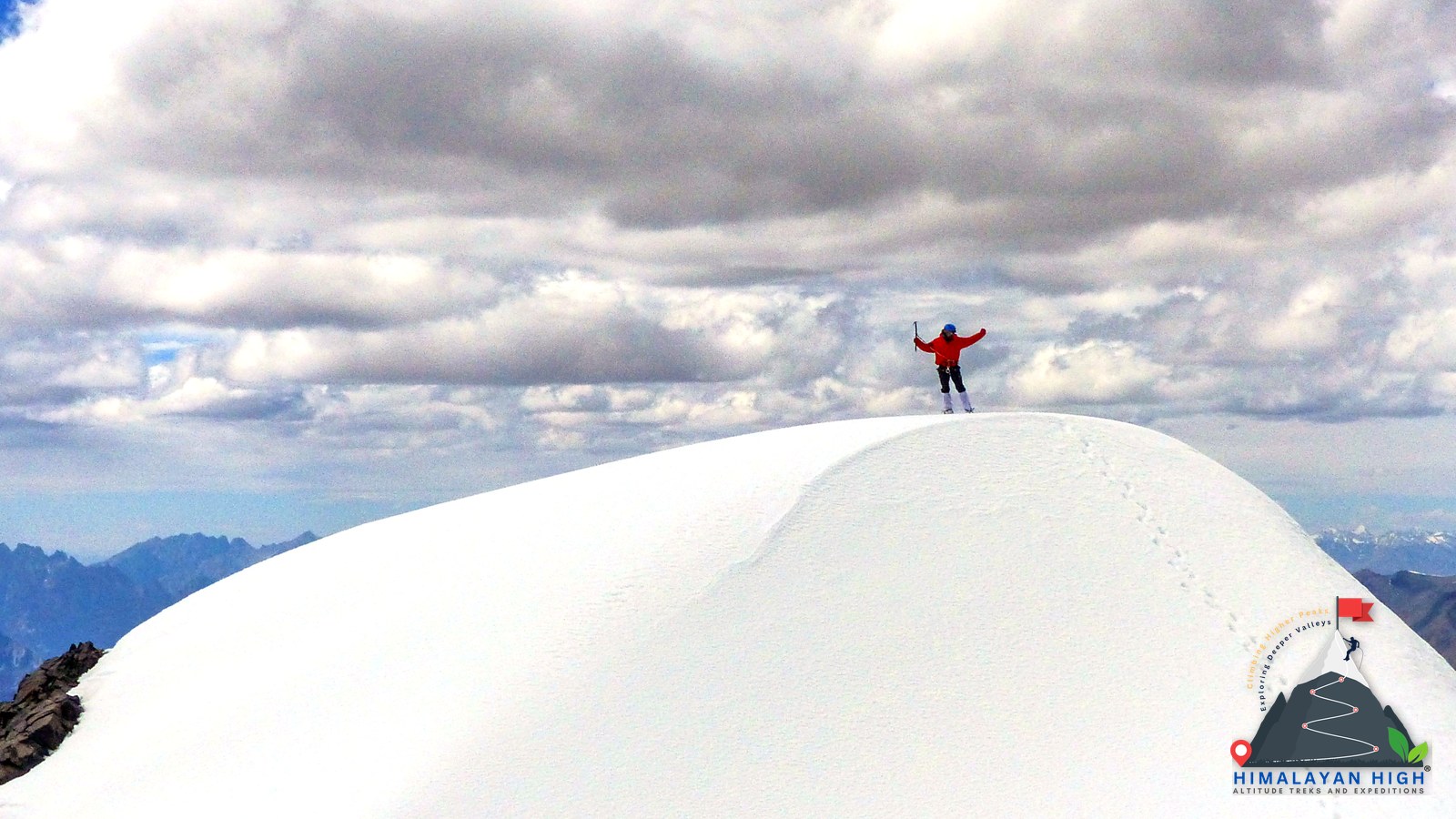
A first 6,000 m peak is within reach of more people than you might think, beginners included. What decides it is rarely a number on a fitness tracker. It is perseverance, resilience, honest preparation and a goal that truly belongs to you. In India, Ladakh is the natural place to start, with peaks such as Kang Yatse 2 and Mentok Kangri climbed in a dry summer. Every 6,000 m climb we run includes a technical practice day and a reserve day for weather.
Here is what readiness really looks like, how we judge it, how to choose the peak and how the climb runs with us.
Numbers don't always win in the mountains
People often ask us for a test. How many kilometres should I run, and in how many minutes? How heavy a pack should I carry? We understand the question. It would be simpler if one number could say yes.
It can't, and twelve years on the ground have shown us why. We have watched the slowest walker in a group finish a trek with real elegance, steady and smiling, and go home a better trekker. We have watched an overconfident, very fit trekker turn back early. Mountain medicine says much the same thing: fitness at sea level doesn't protect you from altitude sickness, and every body adjusts to height at its own pace.
Fitness matters. It just isn't the whole story. What carries people up a big mountain is quieter:
- Perseverance. Summit day starts in the dark and goes on for hours, at a height where every step is work. The people who reach the top are the ones who keep putting one foot in front of the other.
- Resilience. Weather moves summit day. Acclimatisation asks for patience. A cold night, a hard day, a change of plan: the people who take these in their stride do well.
- A calm head. Listening to your body, and to your leader, counts for more up high than speed.
- A goal that's yours. Wanting the mountain for your own reasons, not for a photograph or someone else's list, gets you through the hard hours.
How we judge readiness
No one can put a number on resilience, so we don't try. We talk.
Before we confirm a climb, we ask what you have done in the mountains, how you are preparing, and what you want from this peak and the ones after it. We listen for how you train, how you have handled hard days before, and how honestly you describe where you are. That conversation tells us more than any single test.
If your goal is real and you're working for it, we'll help you get there. You may not be at the level yet, and that's fine. We'll suggest the right peak, the right stepping stone and the right number of days, and build the itinerary around you. We have taken many beginners up their first 6,000 m peak, and some of them have gone on to climb harder mountains in the Himalayas. Every one of them needed a first chance.
If the goal is bigger than the preparation, we'll tell you plainly. Take your time, prepare, and come back. That isn't a no. The peak will still be there, and you will enjoy it far more when you are ready for it.
You don't need to be a mountaineer already. Every expedition includes a technical practice day, and a basic mountaineering course is a great foundation if you plan to keep climbing. A doctor-signed medical certificate is required before arrival for Challenging and Challenging+ treks and for everything above 5,000 m.
Preparing well
Good preparation is steady, not dramatic. In the months before, build the stamina for long days on your feet: regular cardio, long walks with height gain, stairs with a loaded pack. Train your patience too. The climb rewards people who can go slowly and keep going.
If you want a stepping stone first, Friendship Peak (5,289 m, near Manali) and Pangarchula (4,575 m, in Uttarakhand) are good first summits. In Ladakh, Shang La–Matho La makes a good warm-up trek before a peak. There's more in our guide on how to prepare for a high-altitude trek.
Choosing the peak
| Peak | Height | Character | Good for |
|---|
| UT Kangri | Over 6,000 m | Approached from Rumtse; 10 days | A first 6,000 m with a compact itinerary |
| Kang Yatse 2 | 6,223 m | Approached through Markha and Nimaling; 11 days | A classic first summit, with a beautiful trek approach |
| Mentok Kangri | 6,250 m | Above Tso Moriri, with a Korzok acclimatisation day; 11 days | A first summit with a lake landscape; it can be added to the Rumtse–Tso Moriri trek |
| Dzo Jongo West | 6,280 m | Semi-technical, with crevasses and moraine; 12 days | A second peak, or a first for those with some snow experience |
Once you've climbed one, the next steps include Kang Yatse 1 (6,405 m, with fixed ropes on exposed sections), Chakula (6,534 m, semi-technical, with base camp at 5,300 m and an advanced base at 5,900 m), Kang Yatse 1 and 2 together, and eventually Mt. Nun (7,135 m). You can see all our higher climbs in Beyond 6,000 m, and the region in our Ladakh, Zanskar and Spiti guide.
How we run a 6,000 m climb
A slow start in Leh. You fly into Leh and spend the next day acclimatising around town. Some peaks add a second acclimatisation day or an acclimatisation loop before heading out.
An approach that does the work. Most peaks are reached on a trek, so you gain height gradually and arrive at base camp better adjusted. Kang Yatse 2's approach through the Markha Valley is a good example.
A technical practice day. Before the summit, there is a dedicated day to learn and practise what you'll need: walking in crampons, using an ice axe, moving roped together, and what to do on the slope.
Guide support. Our guide ratios are 1:2 on every Challenging and Challenging+ trek and every summit above 6,000 m, in every comfort setting; otherwise 1:6 Lean, 1:4 Standard, 1:3 Premium.
A reserve day. Every summit above 6,000 m has a flexible reserve day for weather or a slower day.
The same safety standard as every trip: a high-altitude medical kit, a daily oxygen-saturation check, leaders with sound knowledge of high-altitude physiology and emergency protocols, and your health information with us before you start. You can read more in how we pace a high trek.
What success means
Our summit success on peaks above 6,000 m is more than 85%, and we have a record of zero fatalities and zero injuries since we began, kept by discipline, not luck.
Some days the mountain says no, as it did on Kang Yatse 1 in 2015.
We judge a climb by the decisions made on the mountain, including when to stop. A first 6,000 m peak teaches you how your body and mind work up high. For many, it is the start of something bigger.
When to go
Ladakh's peaks are climbed from June to mid-October, and each peak page gives its own best window. If you're planning for next summer, now is the time to choose the peak and start preparing.
In short
- A first 6,000 m peak is within reach of beginners too, when the goal is real and the preparation shows.
- Readiness is perseverance, resilience and a real goal, not a fitness score. We judge it by talking with you.
- Not ready yet? We'll tell you plainly, and help you prepare.
- UT Kangri, Kang Yatse 2 and Mentok Kangri are good first peaks in Ladakh.
- A technical practice day and a reserve day on every 6,000 m climb.
Thinking about your first 6,000 m? Tell us your goal, what you've done and how you're preparing, and we'll suggest the right peak.