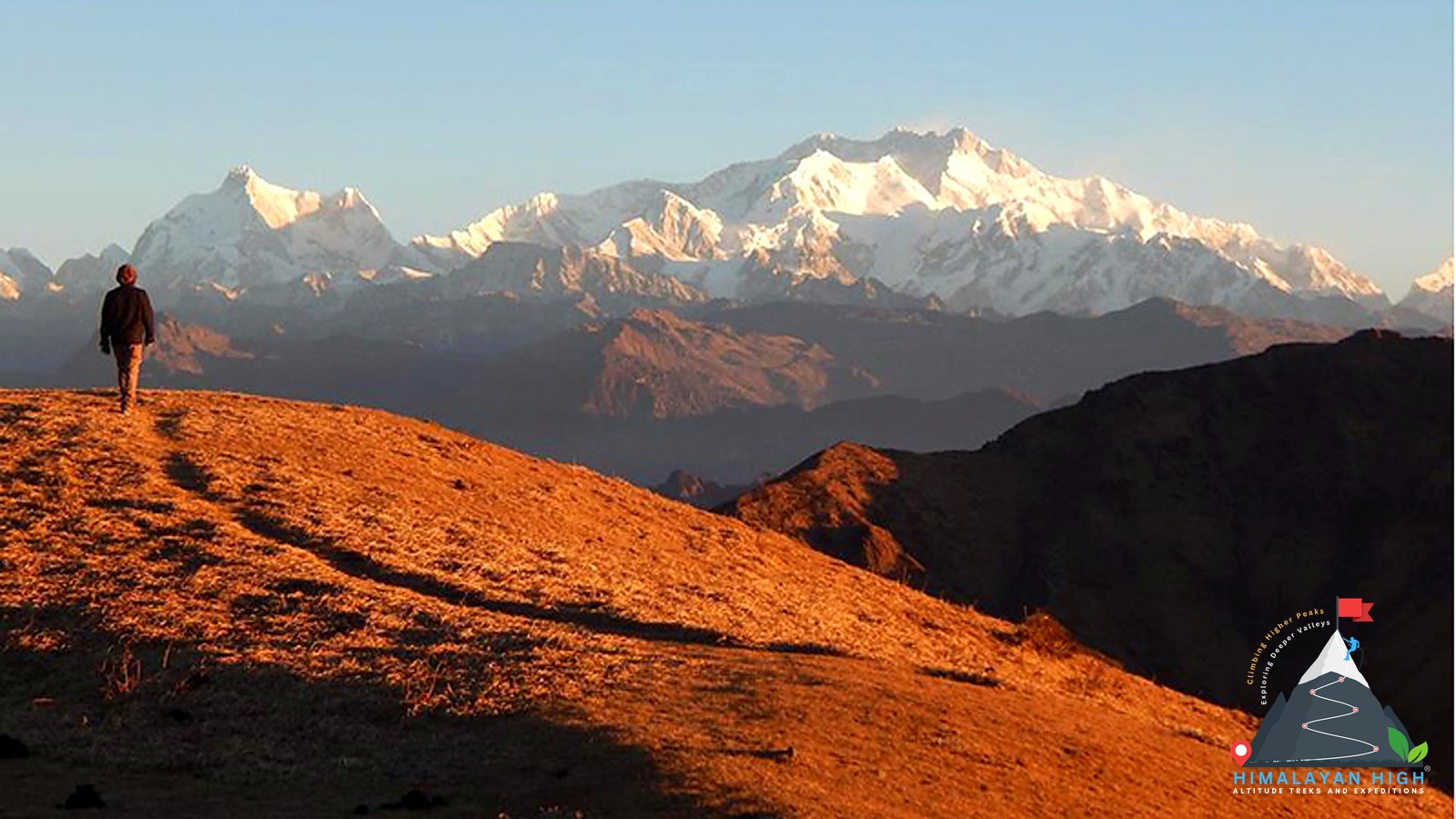
The eastern Himalayas are where we're most at home. From our base at Maneybhanjyang, at the foot of the Singalila Ridge, we run treks along the India–Nepal border to Sandakphu and Phalut, and into West Sikkim to Dzongri and Goecha La, beneath Kanchenjunga. The first choice is simple: a ridge walk with village stays on the Darjeeling side, or a higher camping trek from Yuksom in West Sikkim. The season runs from October to May.
Here is how the main treks compare, who each one suits, and what changes with a foreign passport.
Two ranges, two kinds of trek
The Singalila Ridge (Darjeeling side) is a long ridge on the border with Nepal, inside Singalila National Park. On clear mornings, it looks across to Kanchenjunga and to Everest, Lhotse and Makalu. Most nights are in homestays and trekkers' huts, so the walking is gentler and the logistics lighter. It suits first Himalayan treks, families and solo trekkers.
West Sikkim (Yuksom side) climbs into Khangchendzonga National Park, towards the glaciers and the east face of Kanchenjunga. It is higher, wilder and mostly camping. It suits people with some trekking behind them, or a strong first-timer with good fitness.
The Singalila Ridge treks
Sandakphu Phalut (7 days from Bagdogra and back, Easy; Sandakphu 3,636 m, the Phalut sunrise viewpoint 3,700 m). This is our signature eastern trek, led by an experienced and local trek leader. A short Land Rover ride takes you to Tumling, then you walk via Tonglu and Kalapokhari to Sandakphu. We stay at Aalley, about a kilometre into Nepal, away from the Sandakphu crowds. Then it's on along the ridge to the trekkers' huts at Molley and Phalut, down to the village of Gorkhey, and out through Rammam. If you have the days, add Phalut: it's the ridge's finest viewpoint.
On a foreign passport? Foreign nationals on an Indian visa can't stay overnight in the Nepal-side villages, so we plan Indian-side stops (Tonglu instead of Tumling, and straight on to Sandakphu). That makes one walking day longer. There are 7-day and 6-day foreigner plans.
Short on time? Sandakphu in 5 days (four days on the trail) reaches Sandakphu and comes down via Gurdum, without Phalut.
Phalut (6 days). It goes in from the quieter Rammam side to Molley and Phalut, and back through Gorkhey. It's good if you want the ridge's finest viewpoint without Sandakphu.
Phoktey Dara (7 days, up to 3,800 m, Easy). It starts from Uttarey in West Sikkim and camps at Acchaley and Kalijhar, with Phoktey Dara and the Singalila Pass before Phalut and Gorkhey. It's a less busy alternative to Sandakphu, with a little more wilderness.
Chintafu, Sandakphu and Phalelung (8 days, Moderate; Chintafu 3,353 m, Sandakphu 3,636 m). This is the Singalila Ridge from its quiet side. You cross into Nepal at Kakarbhitta, drive up through the tea hills of Ilam, and walk from homestay to homestay through rhododendron, bamboo and red panda country to Chintafu, one of Ilam's highest points. Then the big ridge opens ahead of you: Dhuppitar, Sandakphu, a night at remote Sabargram, Phalut at sunrise, and down through Gorkhey to Rammam. It is a rare traverse, and very few trekkers walk it.
Who can go: Indian trekkers need no permits; carry a passport or Voter ID for the border. Travellers on foreign passports can fly into Bhadrapur on a Nepal visa for our Nepal-only version, through Ilam, Chintafu and Sandakpur to the remote Phalelung highlands. With multiple-entry visas for both India and Nepal, the full crossing works too, though for most foreign travellers Sandakphu Phalut is the simpler choice.
The Full Singalila Traverse (23 days, up to 4,800 m, Strenuous). This is the whole ridge and beyond: Phoktey Dara, the high lakes, Dzongri, the Rathong Glacier, Goecha La and Kasturi La. It is almost all camping, for experienced trekkers with time.
For wildlife lovers, our Red Panda Expedition spends four days in the park with local trackers. Sightings are never guaranteed, and we say so.
The West Sikkim treks
Dzongri La (8 days, up to 4,300 m, Moderate). It goes from Yuksom through Tshoka to Dzongri, with a sunrise climb to Dzongri Top facing Kanchenjunga, and Dzongri La above the Rathong valley. It's a fine introduction to Sikkim's high country.
Goecha La (10 days, Moderate+). This is the classic Sikkim trek: Yuksom, Tshoka, Dzongri, Thansing and Lamuney, then up to Goecha La View Point 1 (4,600 m), our turnaround beneath Kanchenjunga, with Samiti Lake on the way back down. We spend the second day at Yuksom, walking to Dubdi Monastery and Kathok Lake, to settle in before the climb.
Goecha La and Kasturi La Circuit (12 days, Strenuous). It goes up to the Goecha La viewpoint, then crosses Chamrey and the Lampokhari lakes over Kasturi La and walks out via Labdang instead of returning to Yuksom.
Green Lake (North Sikkim, up to 5,050 m, Moderate+). From Lachen up the Zemu valley to Green Lake (5,050 m) and the Kanchenjunga viewpoint (5,200 m). It is camping on the trail, with approach stays in Gangtok and Lachen and an acclimatisation day on the way. It is remote and serious, for experienced trekkers.
When to go
The eastern season runs from October to May. Singalila National Park closes from mid-June to mid-September for the monsoon.
- Spring (March to May): warmer days, forest in bloom, and longer days on the trail. Mornings are often the clearest time; afternoons can cloud over.
- Autumn (October to November): settled weather and often the clearest views of the year.
- Winter (December to February): cold, quiet and often crisp. The ridge treks run, and snow is possible but never promised.
We won't promise you a clear view of Kanchenjunga on any particular day. The mountains decide, and a good itinerary gives you more than one morning to see them.
Permits, and a rule for solo foreigners
We arrange all the permits. What you need depends on where you go and your nationality.
- Singalila Ridge: a national park permit and a registered guide beyond Tumling. Foreign nationals carry their passport and visa for border checks along the ridge.
- Sikkim: foreign nationals need a Restricted Area Permit, now applied for online and approved before you reach the Sikkim border. The Goecha La and West Sikkim routes also need a Protected Area Permit, arranged through a registered Sikkim operator. North Sikkim has its own rules.
- Group size: for Sikkim's permit routes, we need at least two travellers on foreign passports, so we can't run Dzongri, Goecha La or Green Lake for a solo foreigner. Indian trekkers can go solo on any of them. For a solo foreign traveller, the Singalila Ridge on the Darjeeling side is the answer, planned around your passport. More in trekking solo in the Himalayas.
Send us passport details early. Permits take time, and we'll tell you exactly what's needed for your route.
Which trek is right for you?
| If you want… | Choose |
|---|
| A first Himalayan trek with big views | Sandakphu Phalut |
| Fewer people, a little more wilderness | Phoktey Dara or Phalut |
| Your first taste of Sikkim's high country | Dzongri La |
| The classic Kanchenjunga trek | Goecha La |
| A full circuit, no retracing | Goecha La and Kasturi La |
| Remote, high and serious | Green Lake or the Full Singalila Traverse |
| A solo trip on a foreign passport | A Darjeeling-side ridge trek, confirmed for your passport |
Every one runs as a private trek in Lean, Standard or Premium; your quote confirms the transfers.
In short
- The season is October to May.
- The Singalila Ridge is gentler, with homestays and huts, and suits first-timers and solo trekkers.
- West Sikkim is higher and wilder, mostly camping, beneath Kanchenjunga.
- We arrange all permits; foreigners need at least two people for Sikkim's permit routes.
- Views are never promised; good itineraries give you more than one chance.
Tell us your dates and how much trekking you've done, and we'll suggest the right eastern trek for you.