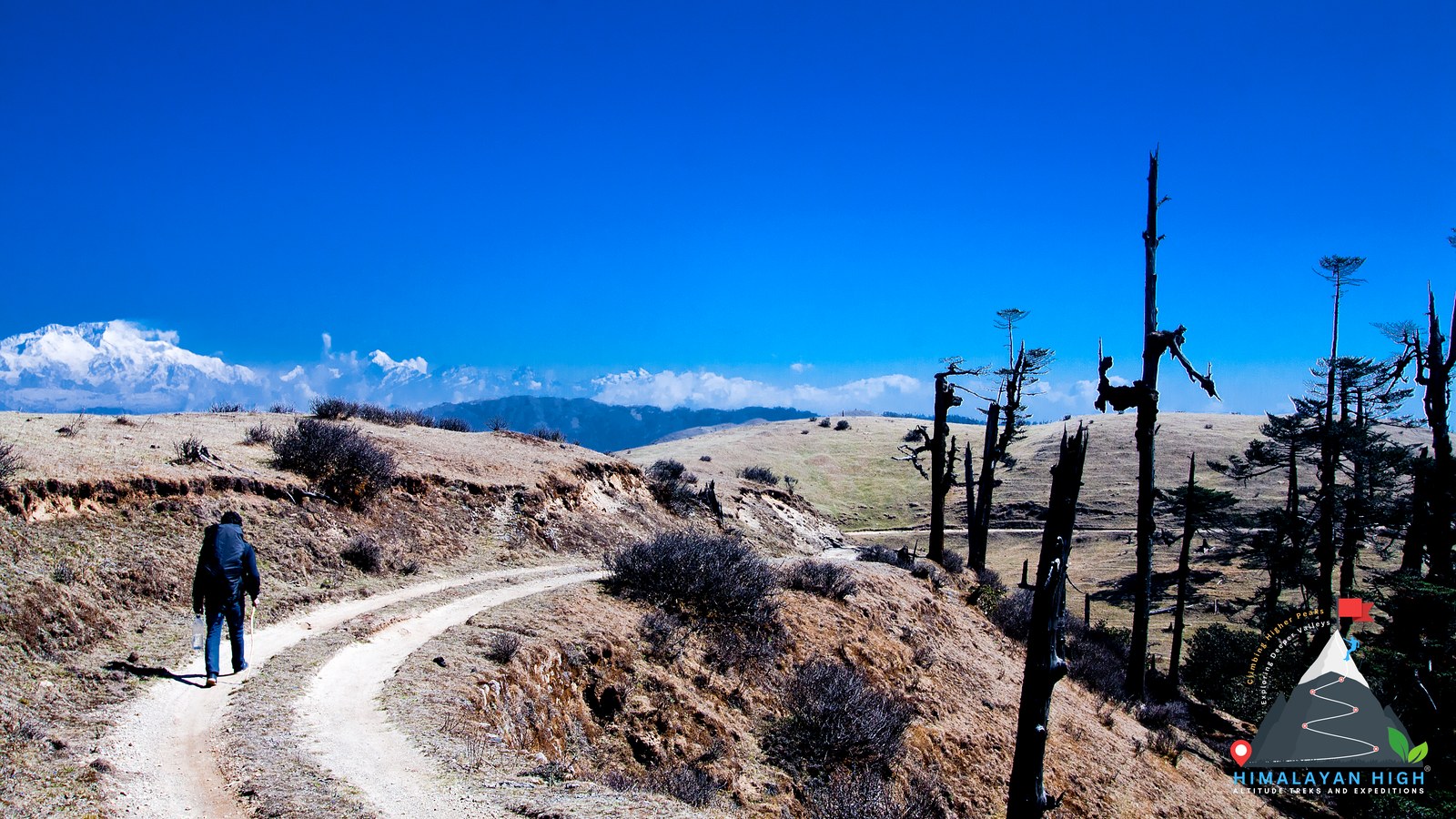
Yes, you can trek the Himalayas alone with us, and you won't be put into someone else's group to make it work. With Himalayan High, one person is a group. A solo private trek is yours alone: your own leader, local route guide and crew, and on a camping trek your own tent and toilet tent. It's priced for one, which is why it costs more per person than trekking with others.
Many people who write to us are travelling alone. Some want solitude, some can't match dates with friends, and some simply want to go at their own pace. Here is how it works, where the limits are, and how to make it sensible.
What a solo trek with us looks like
You arrive at the nearest airport and we take it from there. Your trip leader stays with you from start to finish, and a local route guide walks with you on every trek. Depending on the route and the comfort setting you choose, a cook and helpers run the camp, and mules or porters carry it.
Nobody joins you. The dates are yours, the pace is yours, and the plan bends around you: a slower morning, an extra night at a beautiful camp, a side valley you didn't know about. On a camping trek, you have your own tent and your own toilet tent.
You are also never really alone. Oxygen saturation is measured every day, your health and emergency information is with the team before you start, and the people walking with you know high-altitude physiology, emergency medicine and protocols. The safety standard is the same in every tier, for one person or ten.
Why solo costs more
Much of a private team doesn't shrink for a smaller party: the trip leader, the route guide, the cook and the planning behind the trip are there whether you're one or four. On a group trip, those costs are shared. On a solo trip, they aren't.
You can see this on every trek page, where prices are shown per person by team size. The one-person price is the highest because the whole team is there for one person. Solo already means single: everything on the trip is yours. We explain the full picture in why a private trek costs what it does.
Ways to keep it sensible:
- Choose the Lean setting. It is a complete, safe private trip without the extras. See Lean, Standard or Premium.
- Pick a route that suits one person. On some routes, such as parts of the Singalila Ridge, homestays and simpler logistics can mean a lighter team than a full camping trek.
- Ask about Group Match. It's experimental: if a compatible party forms, we get in touch.
What's possible, and what isn't
We run private treks for one wherever the route, the permits and your experience allow. A doctor-signed medical certificate is required before arrival for Challenging and Challenging+ treks and for everything above 5,000 m.
Sikkim's permit routes need at least two travellers on foreign passports, so we don't offer routes like Dzongri and Goecha La to a solo foreign trekker. Indian trekkers can go solo on any of them. If you're a solo foreign traveller, ask about an eligible Darjeeling-side option on the Singalila Ridge instead, with stays confirmed for your passport.
Guide support on hard ground. Our guide ratios are 1:2 on every Challenging and Challenging+ trek and every summit above 6,000 m, in every comfort setting; otherwise 1:6 Lean, 1:4 Standard, 1:3 Premium.
Who it suits
A solo private trek suits people who want the mountains on their own terms: photographers who need time at the right light, writers and thinkers who want quiet, experienced trekkers chasing a particular pass, and first-timers who would rather learn with a team's full attention than at the back of a big group.
If you're a woman travelling alone, ask us who will accompany you and what accommodation is planned; we'll tell you before you book. And it suits anyone whose leave doesn't line up with anyone else's.
In January 2016, we ran a private winter Sandakphu trek for one guest, with an experienced and local trek leader, staying in the ridge's tea houses.
Before you write to us
Tell us:
- the trek or region you have in mind, or what you want from the trip;
- your dates, or a date window;
- your trekking experience and the highest you've been;
- your nationality (it matters for some permits);
- which comfort setting appeals.
We'll come back with a plan priced for one, and we'll tell you honestly if another route or season would suit you better.
In short
- One person is a group: a solo trek with us is a full private trek.
- Your own leader, route guide and crew; your own tent and toilet tent on camping treks.
- It costs more per person because the whole team is yours.
- Sikkim's permit routes need at least two travellers on foreign passports; Indian trekkers can go solo.
- Lean, a suitable route or Group Match can keep the cost sensible.
Travelling alone? Tell us where you'd like to go, and we'll plan it for one.